
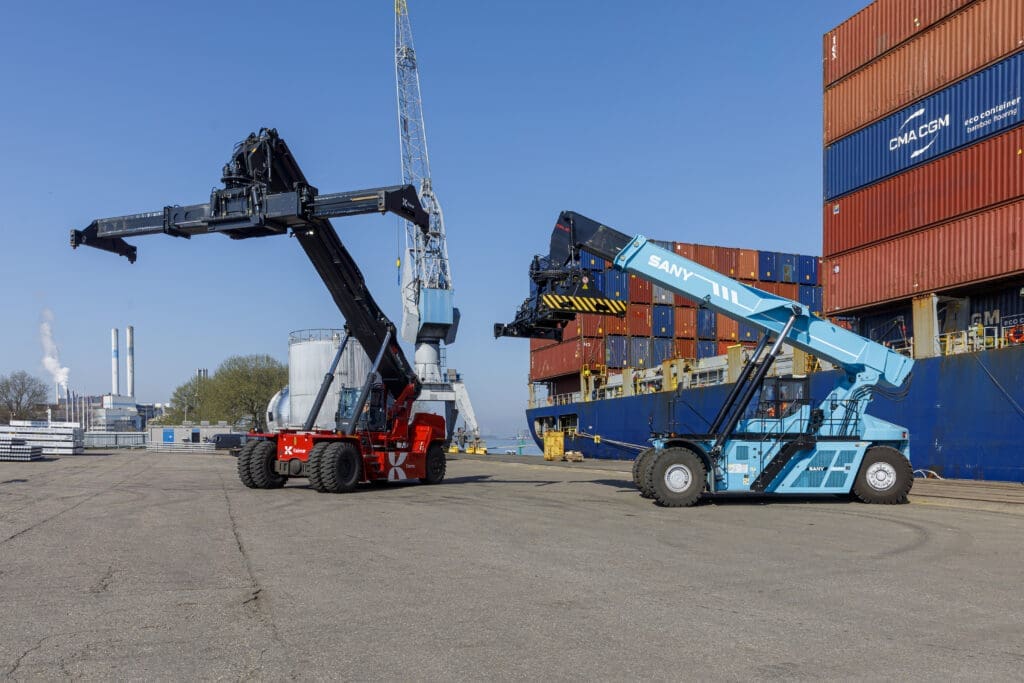
Steinweg Rotterdam has recently taken another step in making its equipment fleet more sustainable with the introduction of new electric reachstackers. The project fits perfectly within the broader ESG ambitions of Steinweg Group. It demonstrates how sustainability, working comfort and technical innovation come together in practice and have a direct impact on daily operations.
The reason behind the investment is clear: Steinweg aims to actively contribute to the reduction targets set within the group. “As a group, we have clear net-zero ambitions, with concrete interim targets for 2035,” says Nicolas Flamant, Director Assets & Infrastructure Development for Steinweg Group. “That means you also need to look at the major consumers within your operation. For us, reachstackers are a key part of that.”
From ambition to reality
Electric forklifts have been part of Steinweg’s operations for some time already. For heavy-duty equipment such as reachstackers, however, the situation was different. The technology had long been seen as promising, but not yet mature enough for intensive port operations.
“A forklift is one thing, but a reachstacker is a completely different story”, Nicolas explains. “We are talking about heavy machinery, high voltage systems, large battery packs and operations that simply have to perform reliably. We only want to step in once the technology has proven itself.”
That turning point came when a test machine was deployed under demanding conditions at one of Steinweg’s locations in Germany. “That is where we saw that electric operation was no longer something for the future, but was becoming a realistic option”, says Nicolas. “That was the moment we started seriously calculating what this could mean for Rotterdam.”
From calculations to concrete impact
The project received support through a subsidy granted by the Port of Rotterdam Authority as part of a European CO₂ reduction programme for the Rotterdam port area. The subsidy helped, but it was not the deciding factor. “A subsidy is a welcome support, but it should never be the only reason to take a step like this. The business model also has to work without it”, Nicolas says.
“In practical terms, this means we are taking six diesel reachstackers out of operation and replacing them with four electric machines”, Nicolas explains. “By using these more efficiently, we can maintain the same capacity with less equipment. In a second phase (Q1 2027), another two diesel machines will be replaced by two electric machines. In addition, we are removing another five diesel reachstackers from the operation without replacing them.”
The result: fewer machines, the same or even better operational performance, and a significant reduction in emissions. Based on internal calculations, the expected CO₂ reduction amounts to approximately 380 tonnes per year. “The strength lies in the combination of technology and smarter deployment of equipment”, Nicolas adds.
Deliberately choosing proven technology
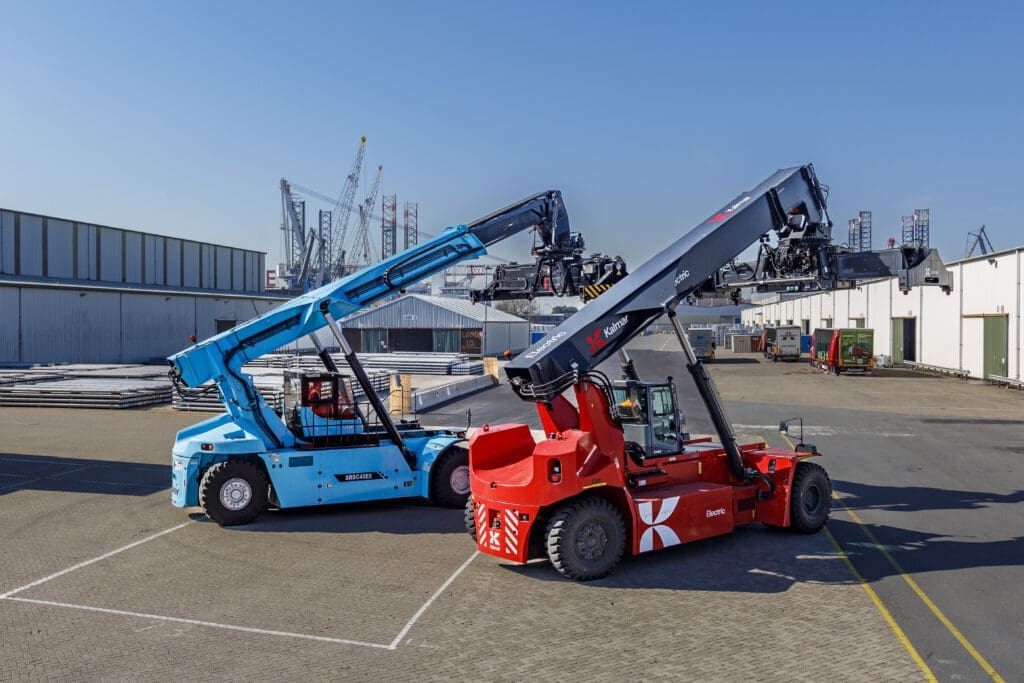
Steinweg approached the selection process with great care. Several manufacturers were consulted, factories were visited and local service organisations were included in the evaluation. Ultimately, Steinweg selected a combination of suppliers: SANY and Kalmar.
“The complete picture has to be right: safety, quality, service, reliability and real operational performance”, Nicolas explains. “It should not be a prototype, but serial technology that is starting to prove itself in practice.”
Risk diversification also played a role in working with multiple suppliers. “Every supplier has strengths and weaknesses. By spreading the risk, you can compare, learn and reduce operational risks.”
The technology must not only work, but also be workable
For Dominic Gruszczynski, Head of Technical Services in Rotterdam, the focus is mainly on practicality: how do you ensure these machines can be operated safely, reliably and in a maintainably fashion? “Nicolas calculates the model and looks at it strategically, but in the end it simply has to work on the terminal”, Dominic says. “Then you look not only at the technology itself, but also at deployment, maintenance, training, the right service partner and the workshop.”
Electric reachstackers require a different technical approach compared to diesel machines. Dominic explains: “These are high-voltage machines. That means different requirements for technicians and for the working environment.”
Less emissions, less noise, more comfort
The advantages of electric equipment are not limited to CO₂ reduction. Working comfort also improves significantly. “For operators, an electric machine is simply more comfortable. Less noise, fewer vibrations, no exhaust fumes and more calm in the workplace”, says Dominic.
According to him, previous experience with electric forklifts helps as well. “That step has already been taken, so people understand what electric operation means.”
Safety requires preparation and expertise
The transition to electric reachstackers goes beyond sustainability and comfort; it also changes the safety landscape. “For me, safety is mainly about proper preparation, the right training and involving people in the transition”, Nicolas explains.
Because these are high-voltage machines, their deployment requires clear procedures, dedicated training and a technical organisation prepared for this type of equipment. Safe working conditions therefore begin long before the machine enters operation.
Bringing people along is the real challenge
According to Nicolas, the biggest challenge is not the technology itself, but the organisation behind it. “Purchasing a machine is the easiest part. The real challenge is bringing people along and ensuring everyone understands why you are taking this step.”
That is why both the technical department and operations were involved from the very beginning. “It has to fit daily practice, otherwise it will not work”, Nicolas says. Dominic agrees: “We were involved from the start to test whether it works in practice. When you involve the people on the ‘shop’ floor, you create understanding and trust. And that is what really makes the difference.”
One project, multiple effects
The arrival of electric reachstackers is not a stand-alone project. It also impacts other areas such as energy management, charging behaviour and grid capacity. Because electrification also means learning how to manage and plan energy consumption intelligently. “That is why we are simultaneously running a project focused on energy management and smarter use of utilities”, Nicolas explains. “How do you charge? When do you charge? How do you use solar energy? How do you align planning and energy consumption? All these elements are connected. Together, these steps reinforce each other and help us build a future-proof operation.”
Leading the way with a well-founded approach
According to Dominic, this clearly shows that the project is part of a broader transition rather than a stand-alone initiative. “The world is changing and we are moving with it.” Steinweg deliberately chooses steps that have a direct impact on the operation: lower emissions, more efficient use of equipment and a working environment that is ready for the future.
SANY on the collaboration with Steinweg
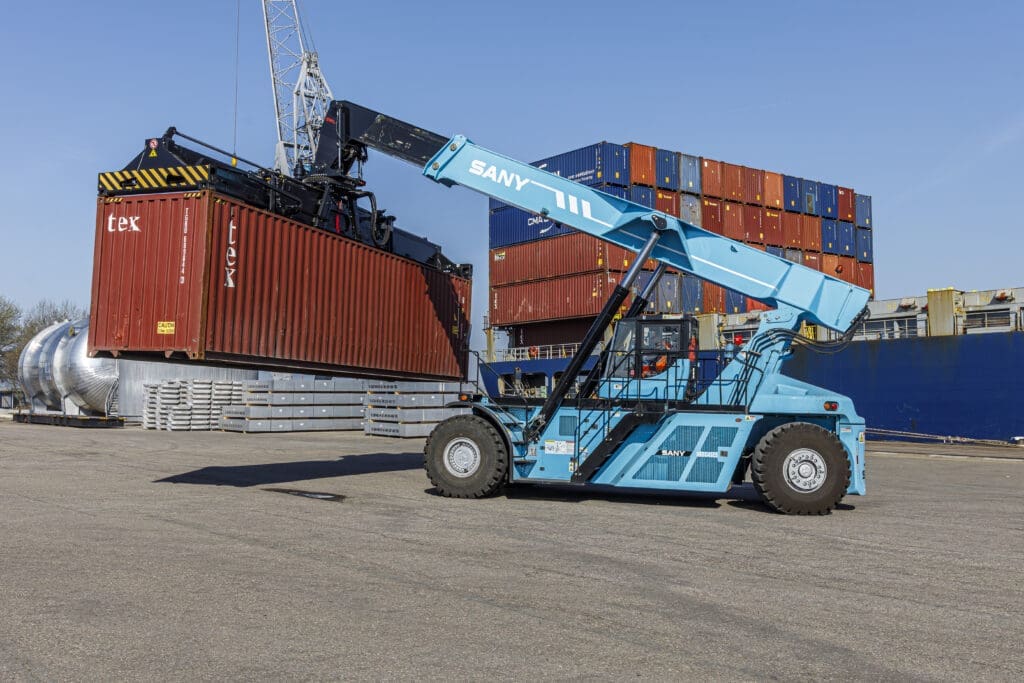
SANY sees the collaboration with Steinweg as a strong example of how partnerships can accelerate change in port operations. “From the start, the collaboration was open and pragmatic, with a clear focus: delivering reliable, high-quality electric reachstackers that perform in practice.”
The delivery of four electric machines marks an important milestone for both companies and for the transition towards more sustainable logistics. Electrification on this scale shows that zero-emission heavy equipment is no longer a future concept, but already a reality.
According to SANY, the strength lies in combining sustainability with operational efficiency. “Terminals can reduce emissions without compromising productivity.” Looking ahead, SANY expects further acceleration. “Innovations in battery technology, charging infrastructure and total cost of ownership will continue to drive this development forward.”
KALMAR on the collaboration with Steinweg
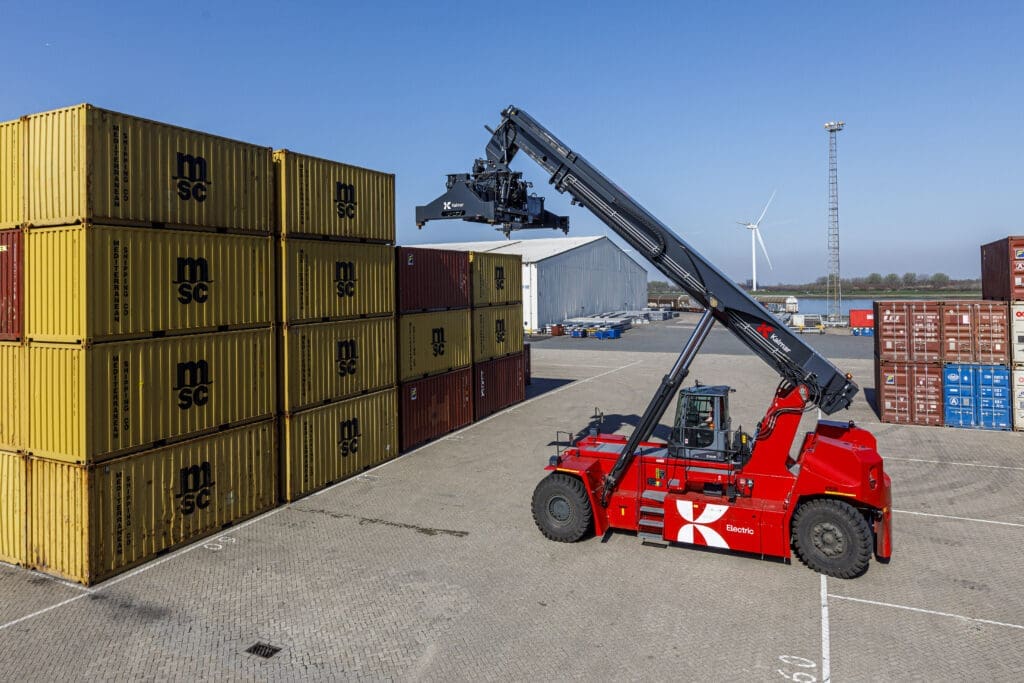
The collaboration between Steinweg and Kalmar dates back to the 1980s, when Kalmar was introduced in the Netherlands and supplied the first heavy diesel forklifts for stevedoring operations. In the 1990s, containerisation emerged, with Kalmar playing a leading role. “That development grew alongside Steinweg. Over the years, we have worked closely together and shared valuable operational experience with our R&D organisation.”
Several generations of machines followed, from the DRD, DRF and DRG series to the current electric ERG range. With the move towards electrification, Steinweg continues that development. “Together, we explored the possibilities and supported Steinweg by deploying two electric reachstackers, allowing them to experience the performance in practice. Combined with our service support, this contributed to the decision to invest in new electric machines.”
The collaboration is now continuing into the next phase. “Together, we are now exploring the electrification of heavy forklifts in the 16 to 42-ton range, a segment in which Kalmar already offers a complete portfolio.”
Published on: 28 May 2026