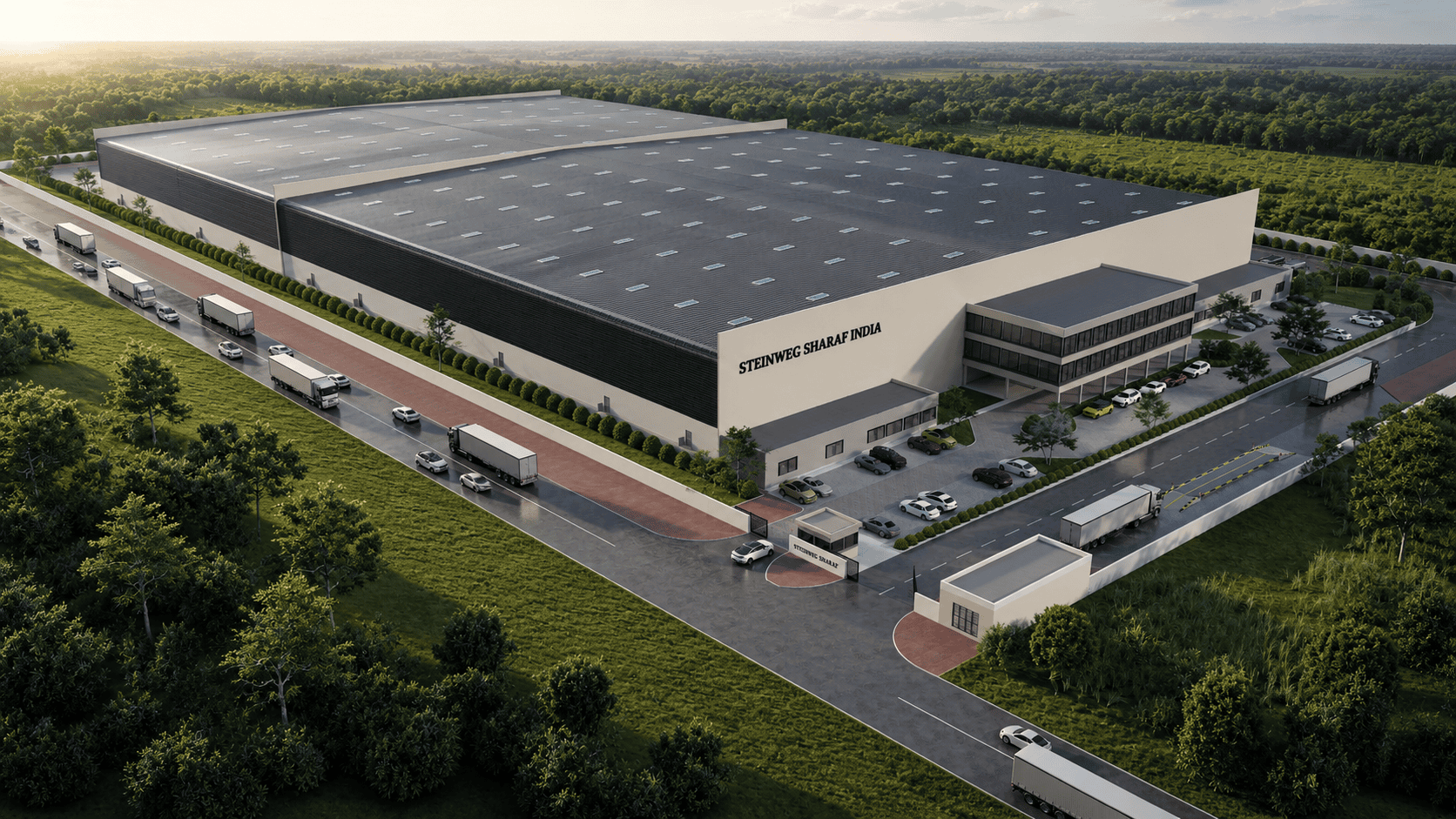
Steinweg-Sharaf is taking the next step in its growth in India with the development of a new warehouse facility at Nhava Sheva near Mumbai. Located directly next to one of India’s most important ports, the investment gives Steinweg-Sharaf greater control over its operations and creates new opportunities for customers. It also marks another step in the company’s long-term ambition to expand its own logistics infrastructure across India.
Steinweg Sharaf (India) Private Limited (SSIPL) was established in 2006 and started operations around 2011. The company is a joint venture between the Steinweg and the Sharaf Group. Sharaf Group is our long-term partner in the Middle East and India, themselves also having a global footprint in logistics. Since then, the company has gradually expanded its footprint across India. Today, SSIPL operates both within Free Trade Warehousing Zones (FTWZs) and the Domestic Tariff Area (DTA). Its FTWZ activities cover five strategic locations on the west and east coasts: Mundra, Nhava Sheva, Chennai, Visakhapatnam (Vizag) and Kolkata (FALTA). In the domestic market, Steinweg operates across 13 Indian states. The next major step is now underway at Nhava Sheva.
From leased capacity to an own facility
Steinweg has been operating in the Nhava Sheva area for many years, using third-party warehouse capacity. SSIPL has now entered in a long-term lease for 12 acres, approximately 48,000 square meters, of land from the Jawaharlal Nehru Port Authority (JNPA). A new Steinweg-Sharaf warehouse facility will be developed on this site. According to Ravi Kashyap, Managing Director for Steinweg-Sharaf, the investment is a logical result of the growth of the business. “Over the years, our business in Mumbai and Nhava Sheva has grown to a level where we can now expand the scope of our activities. Establishing our own facility is the logical next step. It gives us more flexibility and allows us to control our own destiny.”
This approach is familiar within the Steinweg Group, adds Christophe Van Loon, the Regional Director for India and the Middle East. The company often enters a market using rented facilities before investing in its own assets once the business has developed sufficiently. “Steinweg is traditionally quite asset rich. Starting with leased capacity allows us to develop the business, but once we have proven that the market is there, we prefer to invest ourselves wherever possible. Owning the facility gives us much more flexibility and freedom to develop.”
Strategic location at a major gateway
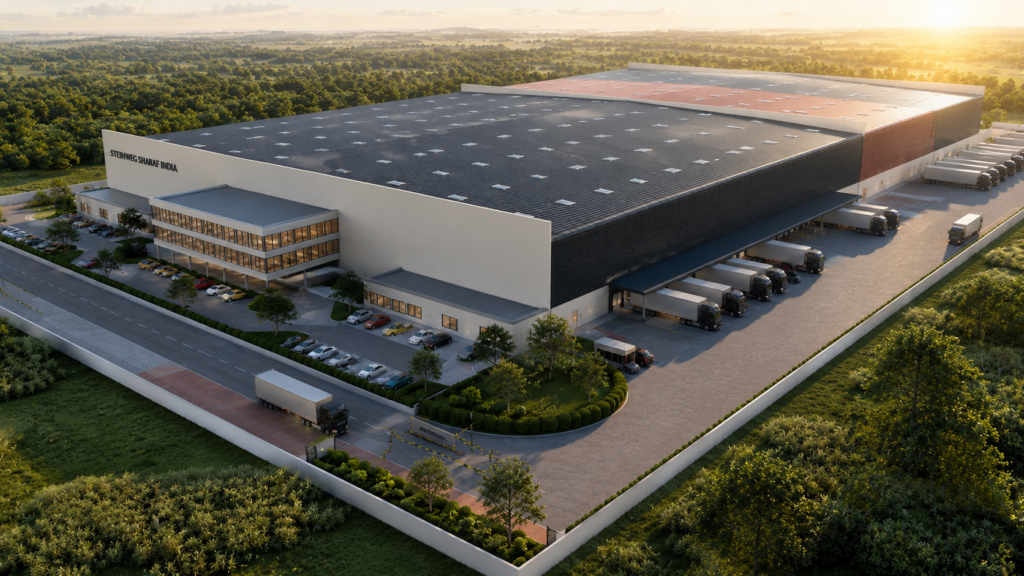
The location is one of the project’s main strengths. The JNP Special Economic Zone and FTWZ are directly connected to Jawaharlal Nehru Port, traditionally one of India’s leading ports. This gives the site an advantage over inland FTWZs, where cargo first needs to travel from the port. A port-based location can reduce transport movements, improve turnaround times and make the logistics chain more efficient.
Western India is also home to a large part of the country’s industrial activity, while Mumbai has long been one of its main financial and commercial centers. “Western India is the heart of a major industrial belt”, Ravi explains. “A lot of raw materials, semi-finished products and finished goods move through this region. Nhava Sheva has traditionally been one of India’s leading ports, so having a strong presence here is critical to the further growth of our company.” With port-based land at JNP limited, a long-term lease gives Steinweg-Sharaf a strategic base from which to develop its activities further.
Built for different cargo flows
The facility will support business segments that are already important to the company in India, including metals and ores, agricultural commodities, chemicals and plastics. At the same time, Nhava Sheva offers opportunities to broaden the cargo portfolio. “Nhava Sheva handles many other cargo flows as well, including general cargo, consumer goods and finished products entering India”, says Ravi. “Alongside our traditional Steinweg and Sharaf businesses, we see opportunities to develop those activities too.”
Flexibility is therefore being incorporated into the development. The initial infrastructure will cater for Steinweg-Sharaf’s existing business, while future phases can be adapted to specific customer and commodity requirements. One area already being considered on our strategic roadmap is the warehousing of chemical products.
Expanding Steinweg-Sharaf’s own network
The Nhava Sheva project is part of a wider development of Steinweg-Sharaf’s own infrastructure in India. The company’s main owned operation is currently in Mundra, Gujarat, where the company has developed a site of approximately 25 acres, around 100,000 square meters, in several phases. On the east coast, Steinweg-Sharaf also owns a facility in Vizag. Nhava Sheva will become its third owned facility in India. “This location is particularly important because of the amount of trade moving through Mumbai and western India”, says Ravi. “We see this facility as an important growth driver for the company in the coming years.”
For Christophe, establishing a substantial own footprint at Nhava Sheva has been an ambition for some time. “We have been looking for the right opportunity to establish our own assets at Nhava Sheva for many years. It is an extremely important location for us. Ultimately, we would like to replicate this approach in other places as well.”
Responding to customer demand
The expansion is also driven by customers already working with the Steinweg Group elsewhere in the world. According to Christophe, the company regularly receives requests from international customers looking for the same support in India. “We get quite a lot of demand from customers within the Steinweg network who already know us from other parts of the world. They want us to support them in India too. That gives us a strong basis from which to develop the business further locally.”
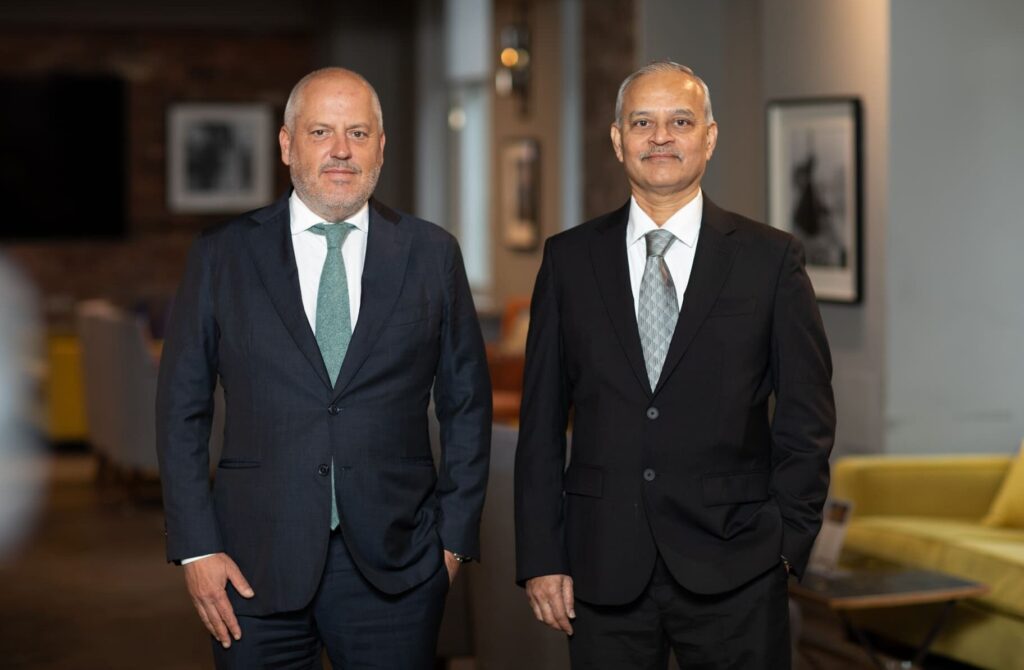
Ravi sees the combination of a local presence and Steinweg, as well as Sharaf’s international network as an important advantage. “What we bring to customers are these global networks behind our local operations. Customers who already work with us elsewhere know our processes and our people. They have a partner they know and trust when they enter or expand in India.” Steinweg-Sharaf is already present in five port-based free zones across the west and east coasts, giving customers access to multiple gateways into the Indian market.
India as a long-term growth market
The investment comes at a time when Steinweg sees significant long-term potential in India. For many years, regulations limited the possibilities to establish the kind of footprint Steinweg has in other parts of the world. Changes to that framework have created new opportunities. At the same time, India’s growing economy, large domestic market and investments in logistics infrastructure provide a strong basis for further expansion.
“India was a missing link within the wider Steinweg network for a long time”, Ravi says. “Today, it is one of the parts of the world where we still see strong growth. For us, that creates opportunities not just for the next few years, but potentially for the next couple of decades.” That potential is already reflected in SSIPL’s operating income. Ravi says the company’s growth has accelerated strongly in recent years. “Over the last three years, our growth has averaged around 30 to 35 percent. That is exciting because it shows that the market is accepting us and recognizing our brand. We now want to build on that momentum over the next five to ten years.”
Operational in 2028
Preparations for the new facility are well underway. The architectural design has been completed and approvals are in process. Steinweg-Sharaf expects to break ground in November 2026.
Because the site has relatively soft soil, ground improvement is required before construction can proceed. The total construction period is expected to take around 16 to 18 months. If everything proceeds according to plan, the new facility will become operational in the first quarter of 2028.
For the Steinweg Group, the project is therefore about more than adding warehouse capacity. It strengthens the company’s own infrastructure at one of India’s key logistics gateways and creates a platform for further growth in a market that is becoming increasingly important within our global network. We are there.